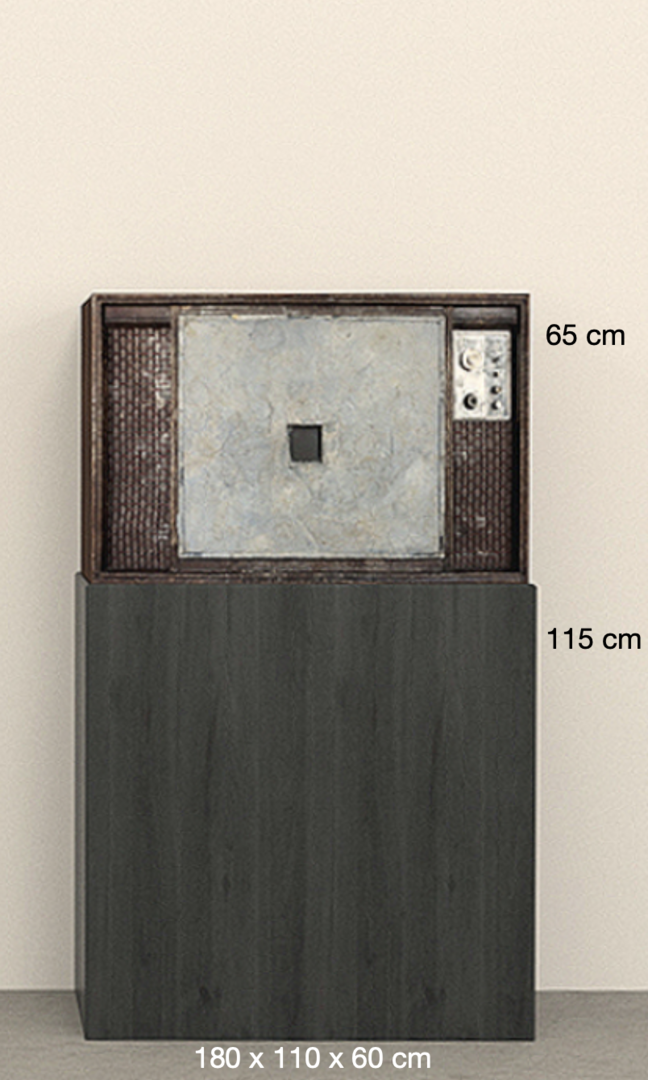
Wolf Vostell "Endogene Depression", 1980
Original, signiert. Mind condition
Wolf Vostells TV-Beton-Skulpturen gehören zu den charakteristischsten und zugleich gedanklich radikalsten Werkgruppen seines künstlerischen Schaffens. Sie sind weit mehr als eine Verbindung von Fernsehapparat und Beton. In ihnen verdichtet sich ein wesentlicher Teil von Vostells Kunstverständnis: die kritische Auseinandersetzung mit Technik, Massenmedien, Konsumgesellschaft, Zerstörung und der Rolle des Menschen in einer zunehmend medial bestimmten Welt.
Vostell verwendete reale Fernsehgeräte, die er in Beton einbettete, teilweise vollständig umschloss oder als integralen Bestandteil massiver Betonkonstruktionen einsetzte.
Dabei treffen zwei scheinbar gegensätzliche Materialien und Bedeutungswelten aufeinander:
Der Fernseher: Er steht für Aktualität, Geschwindigkeit, Information, Manipulation und die permanente Bilderflut der modernen Gesellschaft.
Der Beton: Er symbolisiert Dauerhaftigkeit, Schwere, Unbeweglichkeit, Architektur und nicht zuletzt die materielle Realität.
Der Fernseher wird gewissermaßen gefangen genommen, konserviert oder seiner ursprünglichen Funktion beraubt. Gleichzeitig bleibt er als technisches und gesellschaftliches Symbol präsent
Vostell beschäftigte sich früh mit der zunehmenden Macht der Massenmedien. Das Fernsehen war für ihn nicht einfach ein technisches Gerät, sondern ein Instrument, das Wahrnehmung, Denken und gesellschaftliches Verhalten beeinflusst.
Indem er Fernsehgeräte in Beton einschloss, stellte er eine grundsätzliche Frage:
Was geschieht mit einer Gesellschaft, die ihre Wirklichkeit zunehmend durch elektronische Bilder wahrnimmt?
Die TV-Beton-Skulpturen lassen sich als Kritik an der Passivität des Fernsehkonsums, an der Manipulierbarkeit der öffentlichen Meinung und an der Entfremdung des Menschen durch technische Medien verstehen.
Beton als künstlerisches und politisches Material
Beton hatte bei Vostell eine besondere Bedeutung. Er war nicht nur ein Werkstoff, sondern ein Träger historischer und gesellschaftlicher Assoziationen. Man kann dabei auch an die Architektur der Nachkriegszeit, an Bunker, Schutzräume und die monumentale Ästhetik moderner Städte denken.
Die Kombination mit dem Fernseher erzeugt eine Spannung zwischen lebendigem elektronischem Bild und erstarrter Materie.
Das ist auch im Zusammenhang mit seinem Dé-coll/age-Konzept interessant: Zerstörung, Überlagerung, Veränderung und die Auflösung gewohnter Wahrnehmungsmuster sind zentrale Elemente seines Denkens.
Wolf Vostell’s TV Concrete Sculptures
Wolf Vostell’s TV concrete sculptures constitute one of the most distinctive and, conceptually, most radical groups of works within his artistic oeuvre. They are far more than mere combinations of television sets and concrete. Rather, they embody a fundamental aspect of Vostell’s artistic vision: his critical examination of technology, mass media, consumer society, destruction, and the role of the individual in an increasingly media-dominated world.
Vostell used actual television sets, which he embedded in concrete, sometimes completely encasing them or incorporating them as integral components of massive concrete structures.
In doing so, he brought together two seemingly opposing materials and worlds of meaning:
The television: It represents immediacy, speed, information, manipulation, and the constant flood of images characteristic of modern society.
Concrete: It symbolizes permanence, weight, immobility, architecture, and, not least, material reality.
In a sense, the television is taken captive, preserved, or stripped of its original function. At the same time, it remains present as a technological and social symbol.
Vostell engaged at an early stage with the growing power of mass media. For him, television was not simply a technical device, but an instrument that shaped perception, influenced thought, and conditioned social behaviour.
By encasing television sets in concrete, he posed a fundamental question:
What happens to a society that increasingly perceives its reality through electronic images?
The TV concrete sculptures can be understood as a critique of the passive consumption of television, the susceptibility of public opinion to manipulation, and the alienation of the individual through technological media.
Concrete as an Artistic and Political Material
Concrete held a particular significance for Vostell. It was not merely a material, but also a medium charged with historical and social associations. Its connotations evoke, among other things, post-war architecture, bunkers, shelters, and the monumental aesthetic of modern cities.
Its combination with television creates a tension between the living electronic image and solidified matter.
This is also particularly relevant in the context of Vostell’s concept of Dé-coll/age, in which destruction, superimposition, transformation, and the dissolution of familiar patterns of perception are central elements of his artistic thinking.

 Druckversion
